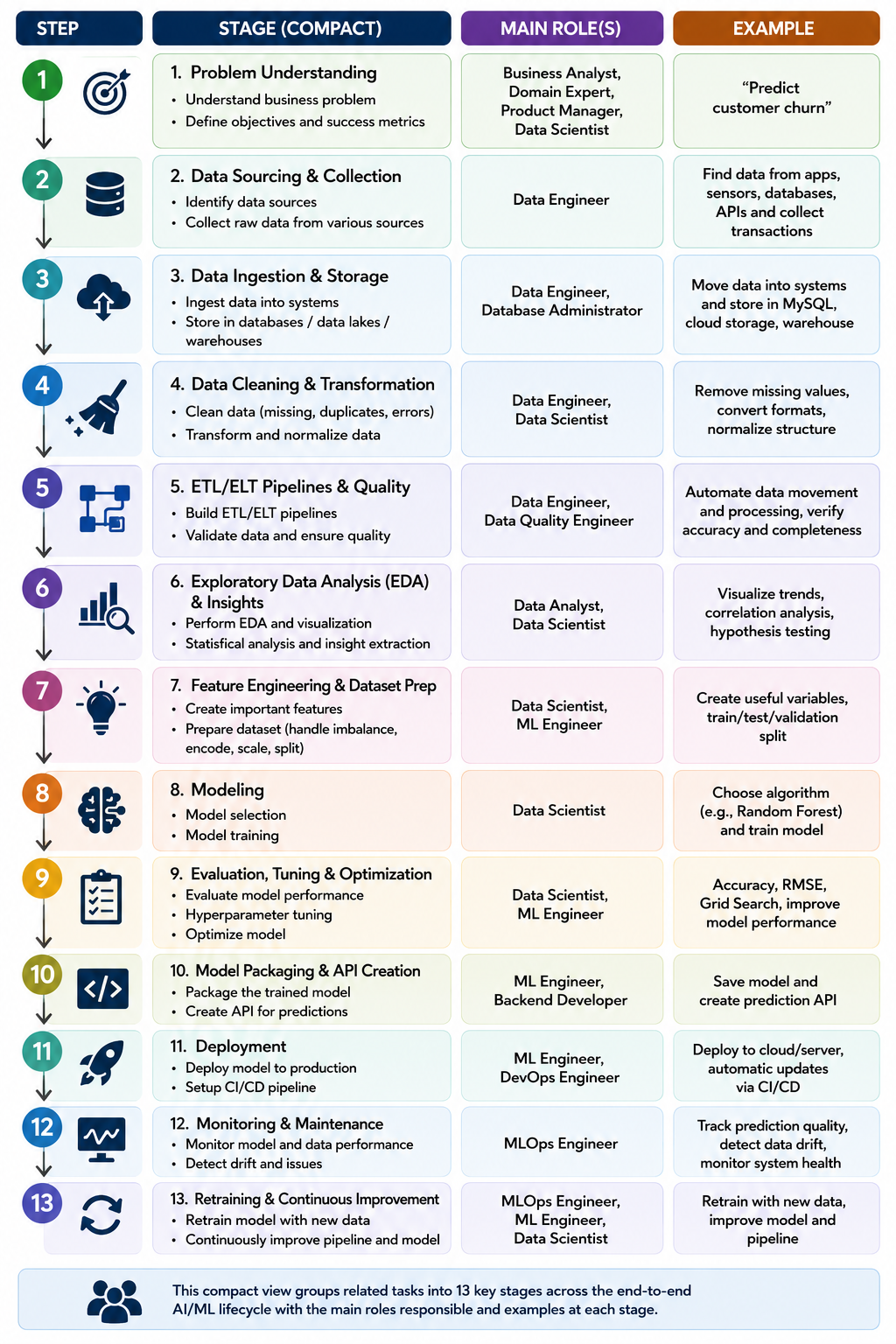
AI ML Life Cycle
AIML Life Cycle
The AIML Life Cycle is a step-by-step process used to build, train, deploy, and maintain Artificial Intelligence and Machine Learning systems.
It helps in solving real-world problems using data and intelligent models.
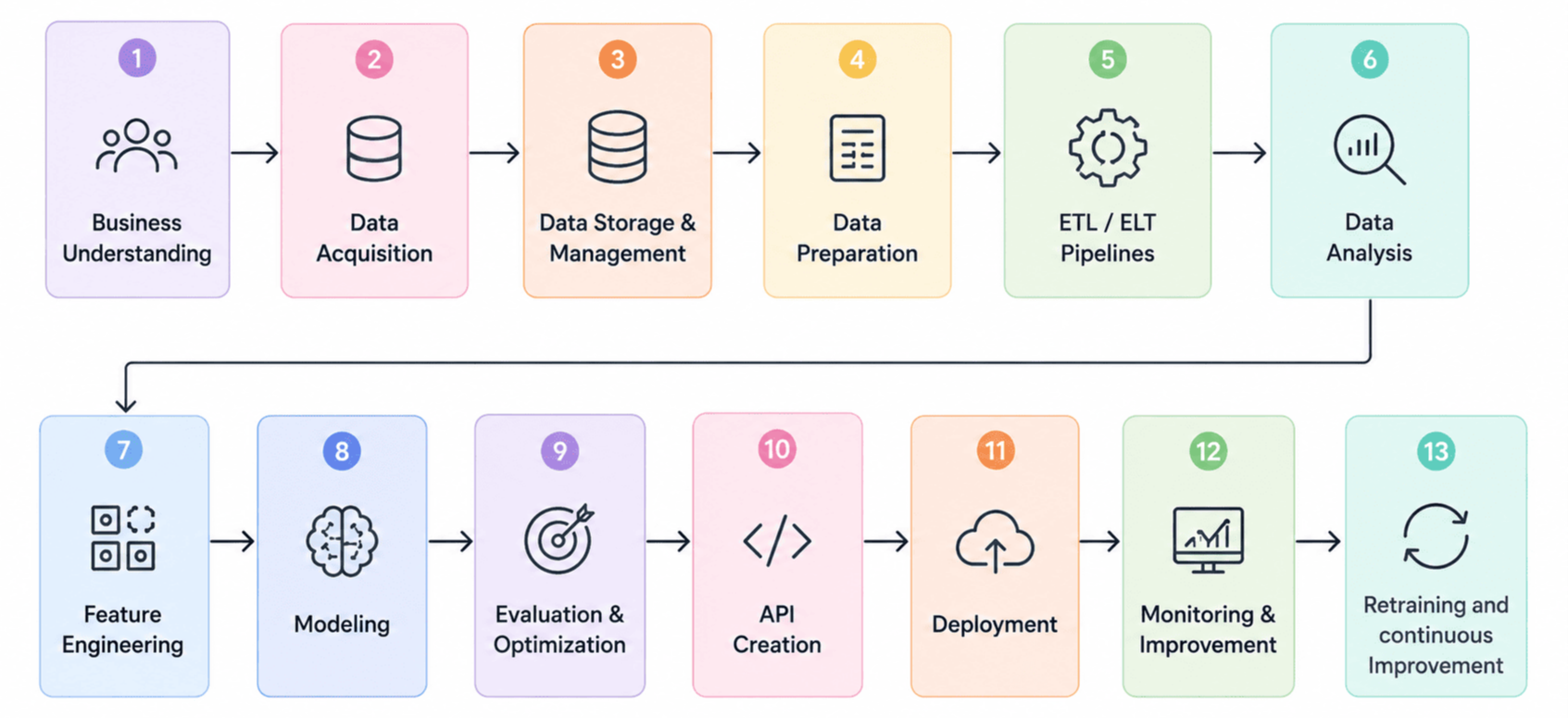
AIML Lifecycle Block Diagram
1. Business Understanding
- First stage of the AI/ML lifecycle.
- Focuses on understanding the business problem.
- Defines what needs to be solved and why.
- Aligns AI/ML objectives with business goals.
- Establishes the foundation for the entire project.
- Business Understanding defines the business problem, project goals, and success criteria before any data-related work begins.
Activities Performed in this stage
Define the Business Problem
- Identify the problem to be solved.
- Understand the business challenge.
Gather Requirements
- Collect requirements from stakeholders.
- Understand project expectations.
Set Project Goals
- Define clear and measurable objectives.
- Establish project deliverables.
Define Success Criteria
- Determine how success will be measured.
- Set performance targets and KPIs.
Understand User Needs
- Identify end users and their requirements.
- Understand user expectations and pain points.
Main Roles Involved
Business Analyst (BA)
- Understands business requirements.
- Bridges the gap between business and technical teams.
Domain Expert
- Provides industry-specific knowledge.
- Helps define the problem accurately.
Product Manager
- Defines project scope and objectives.
- Manages priorities and stakeholders.
Data Scientist
- Evaluates the feasibility of AI/ML solutions.
- Identifies data and modeling requirements.
Example Use Cases
Customer Churn Prediction
- Predict customers likely to leave a service.
Sales Forecasting
- Predict future sales and demand.
Fraud Detection
- Identify suspicious transactions and activities.
Output of This Stage
- Clearly defined business problem.
- Well-defined project objectives.
- Measurable success criteria.
- Identified stakeholders and users.
- Initial project roadmap.
Example
Problem: A telecom company is losing customers.
Goal: Reduce customer churn by 15%.
AI/ML Solution: Build a model to predict customer churn.
Success Criteria: Achieve high prediction accuracy and Reduce customer churn by 15%.
2. Data Acquisition
- Second stage of the AI/ML lifecycle.
- Focuses on collecting data from various sources.
- Ensures sufficient and relevant data is available for analysis and modeling.
- Provides the raw material needed for AI/ML projects.
- Data quality and availability directly impact model performance.
- Data Acquisition is the process of collecting and importing data from various sources for use in AI/ML projects.
Activities Performed
Collect Data from Sources
- Identify and access relevant data sources.
- Gather data required for the project.
Gather Structured Data
- Collect data organized in rows and columns.
- Examples: Databases, spreadsheets, CSV files.
Gather Unstructured Data
- Collect data without a predefined format.
- Examples: Images, videos, audio, documents, social media posts.
Import Data into Systems
- Load collected data into storage systems.
- Prepare data for further processing and analysis.
Main Roles Involved
Data Engineer
- Identifies and connects data sources.
- Collects and imports data into storage systems.
- Ensures data availability and accessibility.
- Maintains data collection pipelines.
Example Data Sources
APIs (Application Programming Interfaces)
- Collect data from external services and applications.
Databases
- Retrieve data from SQL and NoSQL databases.
Websites
- Collect data using web scraping techniques.
Sensors and IoT Devices
- Gather real-time data from machines and devices.
CSV (Comma Separated Values) Files
- Import data stored in text-based files.
Output of This Stage
- Data collected from multiple sources.
- Structured and unstructured data acquired.
- Data stored in accessible systems.
- Raw dataset ready for storage and management.
Example
Problem
- Predict customer churn.
Data Collected
- Customer information from databases.
- Customer complaints from support systems.
- Website activity logs.
- Transaction history from business applications.
Result
- A complete dataset is created for further processing.
3. Data Storage and Management
- Data Storage and Management involves storing, organizing, integrating, and managing data so it can be efficiently used for AI/ML projects.
- Third stage of the AI/ML lifecycle.
- Focuses on storing, organizing, and managing collected data.
- Ensures data is secure, accessible, and scalable.
- Provides a centralized location for data storage.
- Makes data available for analysis and model development.
Activities Performed
Store Collected Data
- Save data in databases, files, or cloud platforms.
- Ensure data is stored securely.
Combine Multiple Data Sources
- Integrate data from different systems and sources.
- Create a unified dataset for analysis.
Manage Databases
- Organize and maintain databases.
- Ensure data consistency and reliability.
Create Data Warehouses
- Store large volumes of historical data.
- Support reporting, analytics, and machine learning.
Main Roles Involved
Data Engineer
- Designs and manages data storage systems.
- Integrates data from multiple sources.
- Maintains data pipelines and infrastructure.
DBA (Database Administrator)
- Manages databases and database servers.
- Ensures data security, backup, and recovery.
- Monitors database performance.
Examples
MySQL Databases
- Store structured business data in relational tables.
Cloud Storage
- Store large amounts of data on cloud platforms.
- Examples: AWS S3, Google Cloud Storage, Azure Blob Storage.
Data Warehouses
- Store integrated and historical data for analytics.
- Examples: Snowflake, Amazon Redshift, Google BigQuery.
Data Lakes
- Store structured, semi-structured, and unstructured data in a single repository.
Output of This Stage
- Data stored securely and efficiently.
- Multiple data sources integrated.
- Databases and storage systems configured.
- Data ready for preparation and processing.
Example
Problem
- Build a customer churn prediction model.
Storage Process
- Store customer records in MySQL.
- Store website logs in cloud storage.
- Combine data from CRM and billing systems.
- Maintain all data in a centralized data warehouse.
Result
- Organized and accessible data is available for the next stage.
4. Data Preparation
- Data Preparation is the process of cleaning, validating, and formatting data to make it suitable for analysis and machine learning.
- Fourth stage of the AI/ML lifecycle.
- Focuses on cleaning and organizing data before analysis.
- Ensures data is accurate, complete, and consistent.
- Improves the quality of data used for machine learning.
- Helps build more reliable and accurate models.
Activities Performed
Clean the Data
- Identify and fix data quality issues.
- Remove unnecessary or incorrect information.
Remove Missing Values
- Handle null or empty values in the dataset.
- Replace, delete, or estimate missing values.
Remove Duplicates
- Identify duplicate records.
- Remove repeated entries to avoid biased results.
Validate Data
- Check data for accuracy and consistency.
- Ensure values follow predefined rules.
Format the Data Properly
- Convert data into a standard format.
- Ensure consistency across all records.
Main Roles Involved
Data Engineer
- Prepares and transforms raw data.
- Ensures data quality and consistency.
- Builds data processing pipelines.
Data Scientist
- Identifies data quality issues.
- Applies preprocessing techniques for modeling.
- Ensures data is suitable for analysis and machine learning.
Examples
Normalize Values
- Scale numerical values to a common range.
Correct Invalid Records
- Fix incorrect or inconsistent entries in the dataset.
Format Dates and Numbers
- Convert dates and numerical values into a standard format.
Handle Missing Values
- Replace missing ages with average values.
- Remove records with excessive missing information.
Remove Duplicate Records
- Delete repeated customer or transaction records.
Output of This Stage
- Clean and consistent dataset.
- Missing values handled appropriately.
- Duplicate records removed.
- Data validated and standardized.
- Dataset ready for further processing and analysis.
Simple Example
Raw Data
| Customer ID | Age | City | Age |
|---|---|---|---|
| 101 | 25 | Pune | 25 |
| 102 | NULL | Mumbai | NULL |
| 101 | 25 | Pune | 25 |
Preparation Steps
- Remove duplicate customer records.
- Fill missing age values.
- Standardize city names.
- Validate data consistency.
Result
- Clean and reliable dataset ready for analysis.
5. ETL / ELT and Pipeline Engineering
- ETL/ELT and Pipeline Engineering automate the extraction, transformation, and loading of data to ensure a continuous and reliable flow of data for AI/ML projects.
- Fifth stage of the AI/ML lifecycle.
- Focuses on moving and processing data efficiently.
- Automates the flow of data between systems.
- Ensures data is available in the right format and at the right time.
- Reduces manual effort through automated data pipelines.
Understanding ETL and ELT
ETL (Extract, Transform, Load)
- Extract data from source systems.
- Transform the data into the required format.
- Load the transformed data into a database or data warehouse.
ELT (Extract, Load, Transform)
- Extract data from source systems.
- Load raw data directly into a storage system.
- Transform the data after loading it into the destination system.
Activities Performed
Extract Data
- Collect data from APIs, databases, files, websites, and sensors.
- Retrieve data from multiple sources.
Transform Data
- Clean, filter, aggregate, and standardize data.
- Convert data into a usable format.
Load Data
- Store processed data in databases, data lakes, or data warehouses.
- Make data available for analysis and reporting.
Create Automated Pipelines
- Automate data movement and processing tasks.
- Schedule pipelines to run regularly without manual intervention.
Main Roles Involved
Data Engineer
- Designs and develops ETL/ELT processes.
- Builds and maintains automated data pipelines.
- Monitors data flow and pipeline performance.
- Ensures reliable and efficient data processing.
Examples
API to Data Warehouse
- Automatically collect data from APIs and store it in a data warehouse.
Database Integration
- Transfer data from operational databases to analytics systems.
File Processing
- Read CSV files, transform the data, and load it into databases.
Real-Time Data Pipelines
- Process sensor or IoT data continuously as it is generated.
Common ETL/ELT Tools
- Apache Airflow
- Apache NiFi
- Talend
- Informatica
- AWS Glue
- Azure Data Factory
Output of This Stage
- Automated data pipelines created.
- Data extracted from multiple sources.
- Data transformed into the required format.
- Processed data loaded into storage systems.
- Reliable data flow established for analytics and AI/ML.
Simple Example
Source
- Customer data available through an API.
ETL Process
- Extract customer data from the API.
- Transform data by cleaning and formatting it.
- Load the processed data into a data warehouse.
Result
- Updated and ready-to-use data becomes available automatically every day.
6. EDA (Exploratory Data Analysis), Data Analysis and Understanding
- EDA, Data Analysis, and Understanding involve exploring data to discover patterns, trends, relationships, and insights before building machine learning models.
- Sixth stage of the AI/ML lifecycle.
- Focuses on understanding the dataset before building models.
- Helps discover patterns, trends, and relationships in data.
- Uses statistical analysis and visualizations to gain insights.
- Supports better decision-making and feature selection.
Activities Performed
Study the Dataset
- Understand the structure and contents of the data.
- Examine variables, records, and data types.
Find Patterns
- Identify recurring behaviors and characteristics in the data.
- Discover hidden information and useful insights.
Find Trends
- Analyze how data changes over time.
- Identify increasing, decreasing, or seasonal patterns.
Analyze Relationships
- Examine relationships between variables.
- Determine how one feature affects another.
Visualize Data
- Create charts and graphs to understand data better.
- Communicate findings effectively.
Main Roles Involved
Data Analyst
- Analyzes data and generates business insights.
- Creates reports and visualizations.
- Identifies trends and patterns.
Data Scientist
- Performs advanced data analysis.
- Studies feature relationships and distributions.
- Uses insights to prepare for machine learning.
Examples
Find Customer Trends
- Identify purchasing behavior and customer preferences.
- Analyze customer retention and churn patterns.
Find Correlations in Data
- Study relationships between variables.
- Determine which features are strongly related.
Analyze Sales Performance
- Identify peak sales periods and seasonal trends.
Understand Customer Demographics
- Analyze age groups, locations, and spending habits.
Common Visualizations Used
- Bar Charts
- Line Charts
- Pie Charts
- Histograms
- Box Plots
- Scatter Plots
- Heatmaps
Output of This Stage
- Better understanding of the dataset.
- Identified patterns and trends.
- Insights into feature relationships.
- Important variables discovered.
- Visual reports and dashboards created.
Example
Problem
- Predict customer churn.
Analysis Performed
- Study customer age, usage, and subscription plans.
- Identify customers with high churn rates.
- Analyze the relationship between customer complaints and churn.
- Visualize churn trends using charts.
Result
- Key factors affecting customer churn are identified.
7. Feature Engineering and Dataset Preparation
- Feature Engineering and Dataset Preparation involve creating useful features, transforming data into machine-readable formats, and preparing datasets for machine learning models.
- Seventh stage of the AI/ML lifecycle.
- Focuses on creating and preparing features for machine learning models.
- Converts raw data into meaningful inputs for algorithms.
- Improves model accuracy and performance.
- Prepares datasets for training, validation, and testing.
Activities Performed
Create Useful Features
- Generate new features from existing data.
- Transform raw data into meaningful information.
Encode Categorical Data
- Convert text categories into numerical values.
- Make categorical data suitable for machine learning algorithms.
Scale Numerical Values
- Standardize or normalize numerical features.
- Ensure features are on a similar scale.
Split Datasets
- Divide data into training, validation, and testing sets.
- Prepare data for model development and evaluation.
Main Roles Involved
Data Scientist
- Identifies important features.
- Creates and transforms features for modeling.
- Evaluates the impact of features on model performance.
ML (Machine Learning) Engineer
- Implements feature engineering pipelines.
- Prepares datasets for model training and deployment.
- Optimizes data processing workflows.
Examples
Convert Age into Age Groups
- Transform age values into categories such as Child, Adult, and Senior Citizen.
Normalize Numerical Data
- Scale values such as salary, income, or sales to a common range.
Encode Categorical Data
- Convert categories like Male/Female or Yes/No into numerical values.
Create New Features
- Calculate customer tenure from registration dates.
- Create total purchase amount from transaction records.
Output of This Stage
- Meaningful and relevant features created.
- Categorical data converted into numerical form.
- Numerical values properly scaled.
- Training, validation, and test datasets prepared.
- Dataset ready for machine learning modeling.
8. Modeling
- Modeling is the process of selecting algorithms and training machine learning or deep learning models to learn patterns from data and make predictions.
- Eighth stage of the AI/ML lifecycle.
- Focuses on building machine learning or deep learning models.
- Uses prepared data to train algorithms.
- Enables the system to learn patterns from data.
- Creates predictive or decision-making models.
Activities Performed
Select Algorithms
- Choose the most suitable algorithm for the problem.
- Select models based on the type of data and objective.
Train ML Models
- Feed training data to the selected algorithm.
- Allow the model to learn from historical data.
Learn Patterns from Data
- Identify relationships, trends, and patterns.
- Build a mathematical representation of the data.
Main Roles Involved
Data Scientist
- Selects appropriate algorithms.
- Trains and fine-tunes models.
- Compares different models and approaches.
- Prepares models for evaluation.
Examples
Train Linear Regression
- Predict continuous values such as sales, revenue, or house prices.
Train Random Forest
- Perform classification and prediction tasks using multiple decision trees.
Train CNN (Convolutional Neural Network) Models
- Analyze images for object detection, image classification, and face recognition.
Train Decision Tree Models
- Make decisions based on data attributes and conditions.
Train KNN (K-Nearest Neighbors) Models
- Classify data based on similarity to nearby data points.
Common Algorithms Used
Machine Learning Algorithms
- Linear Regression
- Logistic Regression
- Decision Tree
- Random Forest
- K-Nearest Neighbors (KNN)
- Support Vector Machine (SVM)
- Naïve Bayes
Deep Learning Models
- Artificial Neural Networks (ANN)
- Convolutional Neural Networks (CNN)
- Recurrent Neural Networks (RNN)
- Long Short-Term Memory (LSTM)
- Transformers
Output of This Stage
- Trained machine learning model.
- Learned patterns and relationships from data.
- Initial predictions generated.
- Model ready for evaluation and optimization.
Example
Problem
- Predict customer churn.
Model Selected
- Random Forest Classifier.
Training Process
- Provide customer data to the model.
- Train the model using historical customer records.
- Learn patterns associated with customer churn.
Result
- A trained model capable of predicting whether a customer is likely to leave.
9. Evaluation and Optimization
- Evaluation and Optimization involve measuring model performance, tuning hyperparameters, and improving the model to achieve the best possible results.
- Ninth stage of the AI/ML lifecycle.
- Focuses on measuring model performance.
- Determines how well the model performs on unseen data.
- Identifies areas for improvement.
- Optimizes the model to achieve better results.
Activities Performed
Evaluate Model Performance
- Test the model using validation or test data.
- Measure how accurately the model makes predictions.
Tune Hyperparameters
- Adjust model settings to improve performance.
- Find the best combination of parameters.
Optimize Accuracy
- Improve model performance through tuning and experimentation.
- Reduce prediction errors and improve generalization.
Main Roles Involved
Data Scientist
- Evaluates model performance.
- Selects appropriate evaluation metrics.
- Performs hyperparameter tuning.
ML Engineer
- Optimizes model efficiency and scalability.
- Automates model tuning and evaluation processes.
- Prepares the model for production environments.
Examples
Measure Accuracy
- Determine the percentage of correct predictions made by the model.
Measure Precision
- Evaluate how many positive predictions are actually correct.
Measure Recall
- Measure how many actual positive cases are correctly identified.
Calculate RMSE (Root Mean Squared Error)
- Measure prediction error in regression models.
Use Grid Search
- Test multiple hyperparameter combinations to find the best model configuration.
Common Evaluation Metrics
Classification Metrics
- Accuracy
- Precision
- Recall
- F1-Score
- ROC-AUC
Regression Metrics
- MAE (Mean Absolute Error)
- MSE (Mean Squared Error)
- RMSE (Root Mean Squared Error)
- R² Score (Coefficient of Determination)
Common Optimization Techniques
- Grid Search
- Random Search
- Bayesian Optimization
- Cross-Validation
- Feature Selection
- Hyperparameter Tuning
Output of This Stage
- Model performance measured.
- Best-performing model selected.
- Hyperparameters optimized.
- Prediction errors reduced.
- Model ready for deployment.
Example
Problem
- Predict customer churn.
Evaluation
- Test the model on unseen customer data.
- Measure Accuracy, Precision, and Recall.
Optimization
- Use Grid Search to find the best hyperparameters.
- Retrain the model with optimized settings.
Result
- Improved model performance and more reliable predictions.
10. Model Packaging and API Development
- Model Packaging and API Development involve saving trained models, creating prediction APIs, and connecting models with applications for real-world use.
- Tenth stage of the AI/ML lifecycle.
- Focuses on preparing trained models for real-world use.
- Makes machine learning models accessible to applications.
- Enables applications to send data and receive predictions.
- Bridges the gap between model development and deployment.
Activities Performed
Save Trained Models
- Store trained models for future use.
- Export models in formats that can be loaded later.
Create Prediction APIs
- Develop APIs that accept input data and return predictions.
- Enable communication between applications and models.
Connect Models with Applications
- Integrate models into web, mobile, and enterprise applications.
- Allow users and systems to access AI/ML predictions.
Main Roles Involved
ML Engineer
- Packages trained models.
- Develops and tests prediction APIs.
- Ensures models are ready for production use.
Backend Developer
- Integrates APIs with applications.
- Manages server-side logic and data flow.
- Ensures reliable communication between systems and models.
Examples
Build Prediction APIs Using Flask
- Create REST APIs that receive data and return model predictions.
Build Prediction APIs Using FastAPI
- Develop high-performance APIs for machine learning applications.
Save Models
- Save trained models using formats such as Pickle, Joblib, or ONNX.
Integrate with Applications
- Connect the model to websites, mobile apps, or business systems.
Common Tools Used
- Flask
- FastAPI
- Django
- Pickle
- Joblib
- ONNX
- Docker
Output of This Stage
- Trained model packaged and saved.
- Prediction APIs developed.
- Model integrated with applications.
- System ready for deployment.
Example
Problem
- Predict customer churn.
Packaging
- Save the trained Random Forest model.
API Development
- Create a FastAPI endpoint that accepts customer details.
- Return the churn prediction as a response.
Result
- Applications can send customer data and receive predictions in real time.
11. Deployment and Automation
- Deployment and Automation involve deploying machine learning models to production environments and automating updates using CI/CD pipelines.
- Eleventh stage of the AI/ML lifecycle.
- Focuses on making trained models available to end users.
- Deploys models into production environments.
- Automates model updates and releases.
- Ensures reliable and scalable model operation.
Activities Performed
Deploy ML Models
- Move trained models from the development environment to production.
- Make models available for real-world predictions.
Automate Deployment
- Reduce manual deployment tasks.
- Enable faster and more reliable model releases.
Create CI/CD Pipelines
- Automate building, testing, and deployment processes.
- Ensure smooth and continuous delivery of updates.
Main Roles Involved
ML Engineer
- Prepares models for production deployment.
- Monitors deployment performance.
- Ensures model reliability and scalability.
DevOps (Development and Operations) Engineer
- Builds deployment infrastructure.
- Creates CI/CD pipelines.
- Automates software and model releases.
- Manages cloud and server environments.
Examples
Deploy Models on Cloud Servers
- Host machine learning models on cloud platforms for real-time predictions.
Deploy Prediction APIs
- Make prediction services available through web APIs.
Automate Model Updates
- Automatically deploy new versions of models when improvements are made.
Containerize Applications
- Package models and applications using containers for easier deployment.
Common Tools Used
- Docker
- Kubernetes
- Jenkins
- GitHub Actions
- GitLab CI/CD
- AWS
- Microsoft Azure
- Google Cloud Platform (GCP)
Output of This Stage
- Model deployed to production.
- Prediction services available to users.
- Automated deployment workflows established.
- CI/CD pipelines configured.
- Scalable and reliable AI/ML system in operation.
Example
Problem
- Deploy a customer churn prediction model.
Deployment Process
- Upload the trained model to a cloud server.
- Deploy the prediction API.
- Configure automated deployment using a CI/CD pipeline.
Result
- Users can access real-time churn predictions through an application.
12. Monitoring and Maintenance
- Monitoring and Maintenance involve continuously tracking model and system performance, detecting issues, and ensuring the AI/ML solution remains accurate, reliable, and efficient.
- Twelfth stage of the AI/ML lifecycle.
- Focuses on tracking model performance after deployment.
- Ensures the model continues to perform accurately.
- Detects issues, failures, and performance degradation.
- Maintains the reliability and stability of AI/ML systems.
Activities Performed
Monitor Model Performance
- Track prediction accuracy and system performance.
- Compare current performance with expected results.
Detect Data Drift
- Identify changes in incoming data patterns.
- Detect when production data differs from training data.
Detect Model Drift
- Identify decreases in model accuracy over time.
- Determine when the model no longer performs well.
Monitor System Health
- Track API response times, server usage, and system availability.
- Detect errors and failures in real time.
Perform Maintenance
- Fix bugs and performance issues.
- Update software dependencies and infrastructure.
Main Roles Involved
ML Engineer
- Monitors model performance in production.
- Detects and resolves model-related issues.
- Recommends model updates when necessary.
DevOps Engineer
- Monitors servers, applications, and infrastructure.
- Ensures system availability and reliability.
- Manages alerts and operational issues.
Data Scientist
- Analyzes model performance trends.
- Investigates data drift and model drift.
- Suggests retraining strategies.
Examples
Monitor Prediction Accuracy
- Check whether model predictions remain accurate over time.
Detect Data Drift
- Identify changes in customer behavior compared to historical data.
Monitor API Performance
- Track API response times and failure rates.
Generate Alerts
- Notify teams when performance drops below a predefined threshold.
Fix Operational Issues
- Resolve deployment, infrastructure, or application problems.
Common Metrics Monitored
Model Metrics
- Accuracy
- Precision
- Recall
- F1-Score
- RMSE
System Metrics
- API Response Time
- CPU Usage
- Memory Usage
- Error Rate
- System Uptime
Common Tools Used
- Prometheus
- Grafana
- ELK Stack
- Datadog
- AWS CloudWatch
- Azure Monitor
Output of This Stage
- Model performance continuously tracked.
- Data drift and model drift detected.
- System health monitored.
- Issues identified and resolved quickly.
- Stable and reliable AI/ML system maintained.
Example
Problem
- A customer churn prediction model is deployed.
Monitoring Process
- Track prediction accuracy every week.
- Monitor API response times.
- Detect changes in customer behavior patterns.
Maintenance Process
- Fix issues when performance drops.
- Update the system when required.
Result
- The model remains reliable and effective in production.
13. Retraining and Continuous Improvement
- Retraining and Continuous Improvement involve updating machine learning models with new data and continuously enhancing their performance to maintain accuracy and business value.
- Thirteenth and final stage of the AI/ML lifecycle.
- Focuses on improving models after deployment.
- Updates models using new and recent data.
- Ensures the model remains accurate and relevant.
- Supports continuous learning and performance improvement.
Activities Performed
Collect New Data
- Gather newly generated data from production systems.
- Include recent user behavior and business data.
Retrain the Model
- Train the model using updated datasets.
- Learn new patterns and trends from recent data.
Improve Features
- Create new features or refine existing ones.
- Remove features that are no longer useful.
Optimize the Model
- Test new algorithms and configurations.
- Improve prediction accuracy and efficiency.
Deploy Updated Models
- Replace older models with improved versions.
- Ensure minimal disruption to users.
Main Roles Involved
Data Scientist
- Analyzes model performance.
- Retrains and improves machine learning models.
- Experiments with new features and algorithms.
ML Engineer
- Automates retraining workflows.
- Deploys updated models to production.
- Monitors model versions and performance.
Data Engineer
- Collects and prepares new data for retraining.
- Maintains data pipelines and storage systems.
Examples
Retrain Customer Churn Models
- Update the model using recent customer behavior data.
Improve Recommendation Systems
- Incorporate new user interactions and preferences.
Update Fraud Detection Models
- Learn new fraud patterns and attack methods.
Enhance Image Recognition Models
- Train on new images to improve recognition accuracy.
Why Retraining is Important?
- Customer behavior changes over time.
- Business requirements evolve.
- New data becomes available.
- Model accuracy may decrease due to data drift and model drift.
- Continuous improvement helps maintain high performance.
Output of This Stage
- Updated and improved model.
- Better prediction accuracy.
- Adaptation to new data and trends.
- Enhanced business value.
- Continuous improvement cycle established.
Example
Problem
- A customer churn prediction model was trained one year ago.
Issue
- Customer behavior has changed.
- Model accuracy has decreased.
Retraining Process
- Collect recent customer data.
- Retrain the model using the updated dataset.
- Evaluate and deploy the improved model.
Result
- Higher prediction accuracy.
- Better business outcomes.
Continuous AI/ML Lifecycle
Monitoring & Maintenance → Collect New Data → Retrain Model → Evaluate → Deploy Updated Model → Monitor Again
This creates a continuous improvement loop that keeps the AI/ML system effective over time.